JCU Seagrass PA (Presence/Absence) Model
A computer vision model designed identify the presence of seagrass from subtidal images. The percent coverage used as reference is from Seagrass-Watch percent cover standards on a 50x50cm quadrat. Please only use the model on images with at least 3% seagrass cover.
Input
The model is trained on an image dataset composed of photoquadrats
collected by drop-camera and SCUBA divers as part as the MMP
(Mckenzie et al., 2022a), the Seagrass-Watch Global Seagrass
Observing Network (Seagrass-Watch, 2022) and the Torres Strait
Ranger Subtidal Monitoring Program (Carter et al., 2021b). Images
were captured between 2014 and 2024 from 28 sites across 18 unique
locations within the coastal and reef subtidal habitats from Torres
Strait to Hervey Bay.
The training dataset included :
- 1455 images with seagrass
- 1455 images without seagrass
Model architecture and training parameters
The seagrass cover class model was developped using YOLO11 classification models. We used the yolo11l-cls.pt as a base for our training. We standardised our input images size to 1088x1088 pixels and used the random augmentation function from ultralytics to prevent overfitting. The model was trained for 100 epochs.
Jocher, G., Qiu, J., & Chaurasia, A. (2023). Ultralytics YOLO (Version 8.0.0) [Computer software]. https://github.com/ultralytics/ultralytics
Model Performance
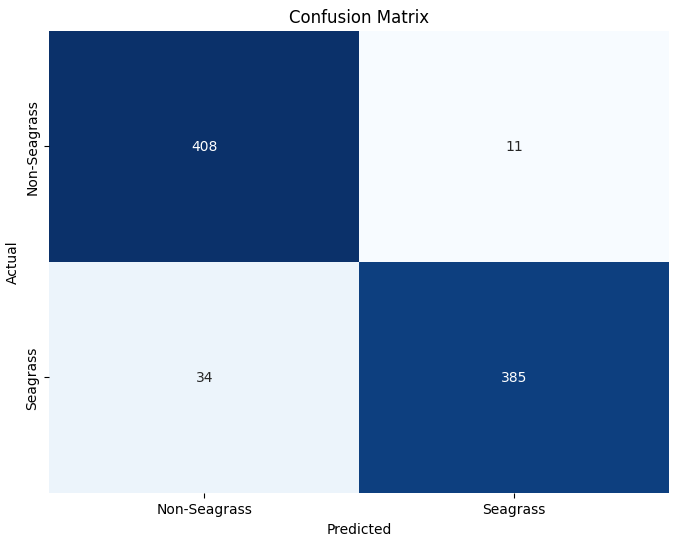
The testing dataset included :
- 419 images with seagrass
- 419 images without seagrass
Model performance metrics :
Accuracy: 0.95
Precision: 0.97
Recall: 0.92
F1 Score: 0.94
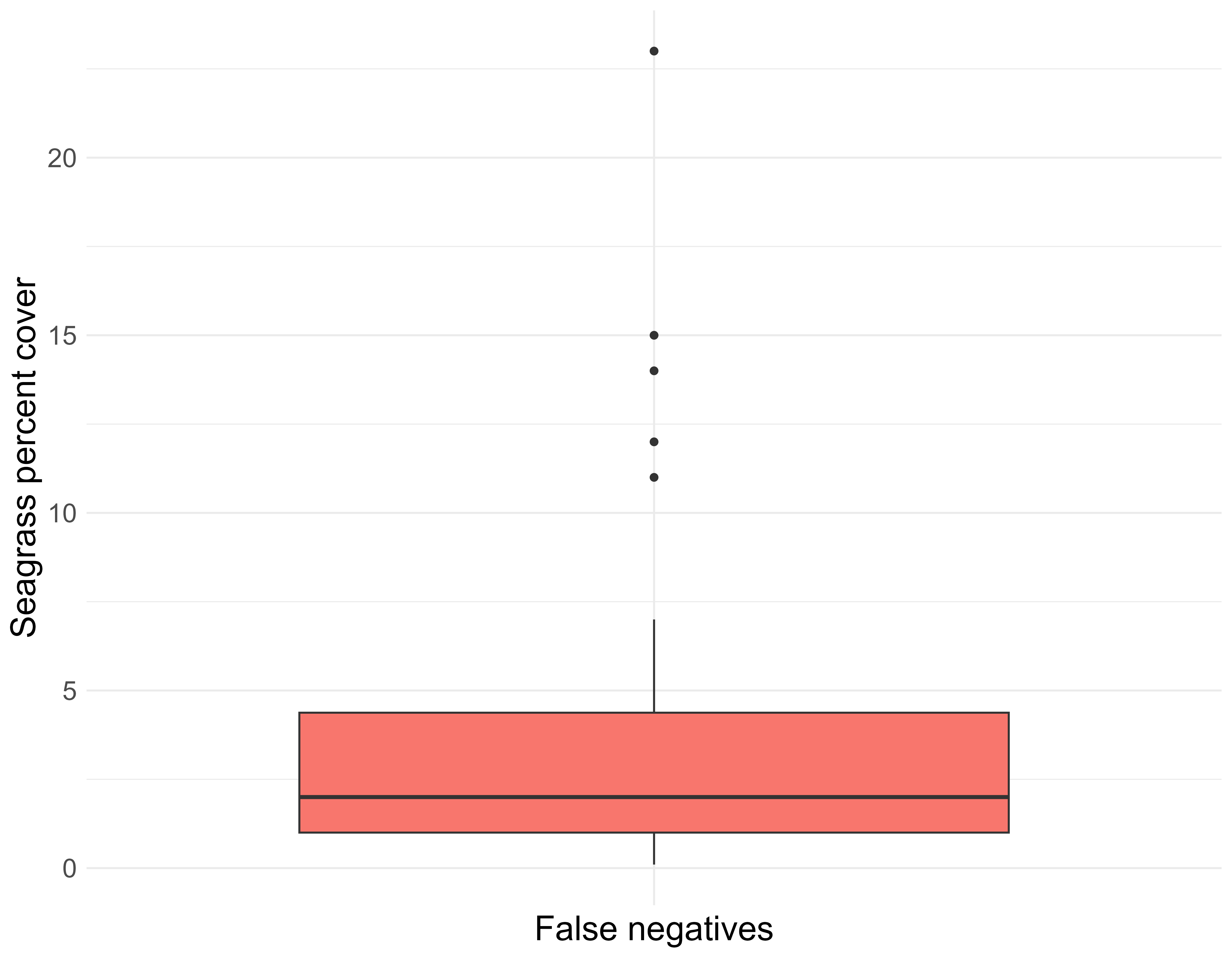
Seagrass percentage cover within the 34 false negatives :
Example
| Example seagrass precence | Example seagrass precence misclassified |
|---|---|
 |
 |
| Example seagrass absence | Example seagrass absence misclassified |
|---|---|
 |
 |
Classes
This model identifies the presence of seagrass in images by classifying them into the following categories:
- Seagrass = percent cover ≥0%
- Non-Seagrass = percent cover 0%
For more information about seagrass percent cover estimates, refer to the Seagrass-Watch percent cover standards.
Annotation Method
Each image was visually assessed for seagrass cover and species composition by a trained seagrass scientist and underwent QAQC according to Seagrass-Watch protocols.
Model Limitations
This model was trained on specific dataset and therefore is finetuned for these specific locations. Model performance will vary on new images and we cannot garanty satifactory results. Please use the result output with caution and determine if this model is suited for your data.
Model Metadata
Tags:
Credits: Lucas A. Langlois, Catherine J. Collier and Len J. McKenzie
Performance on Test Dataset
| Class Group | Accuracy | Support |
|---|---|---|
| Non-Seagrass | 0.9737 | 419 |
| Seagrass | 0.9189 | 419 |